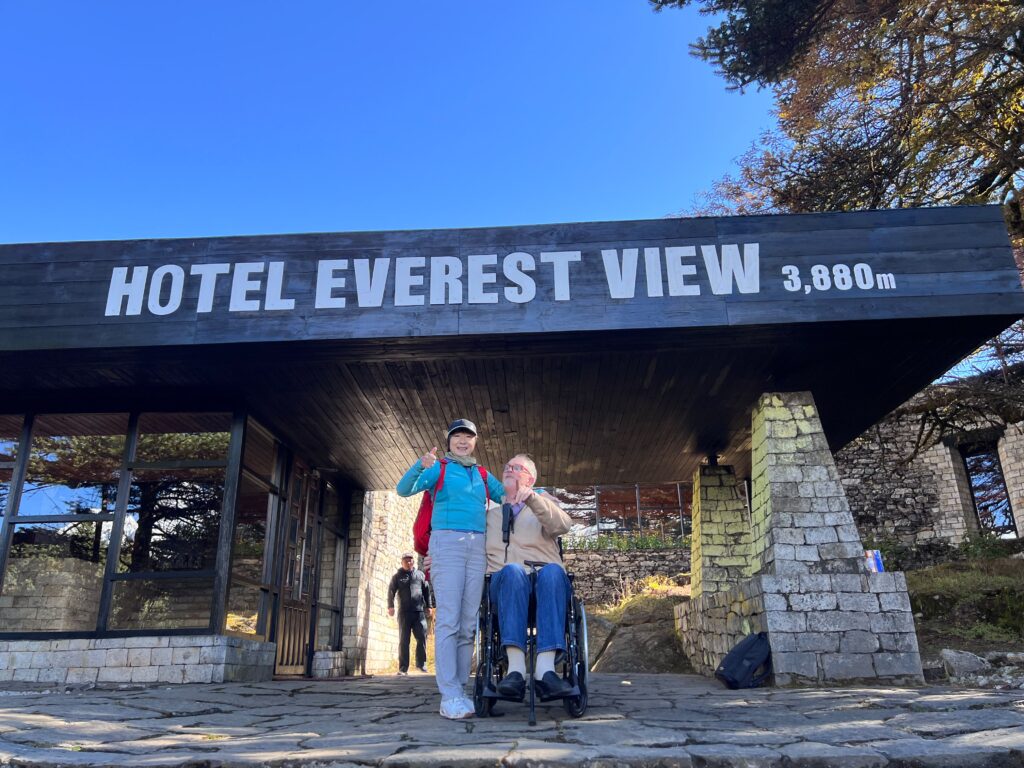
October 2026 journey: participation through traveller-specific planning and support.
Himalayan Circuit Accessible Tours | Kathmandu, Nepal | October 2026
Nepal Is Possible: An Accessible Journey Through Heritage and the Himalayas
Nepal’s terrain is real, and so are its access barriers. An October 2026 journey showed what can become possible when information, transport, pace and human support are designed around the traveller.
Nepal often enters the imagination vertically. Mountain paths climb beyond the tree line. Temple courtyards are paved with stone. Historic squares hold steps, thresholds and centuries of layered architecture. Roads bend through hills, and some of the country’s most celebrated experiences sit far from level pavements and predictable infrastructure.
For a traveller with mobility-related access requirements, the question is therefore understandable: Can I really experience Nepal?
Not simply see it from a distance, but take part in its cultural life, reach a Himalayan viewpoint, share a meal under the mountains and travel with dignity?
Our October 2026 journey did not answer that question with a slogan. It answered through real moments: a wheelchair beside a mountain cable-car setting; movement through living heritage spaces with close assistance; time beneath the great dome of a Buddhist stupa; a shared breakfast in clear Himalayan light; and a high-mountain experience supported by an attentive local team.
The photographs show the result most directly: not spectacle, but participation.
Accessibility is not a label attached to a destination. It is the quality of the match between a traveller, a place and the support connecting them.
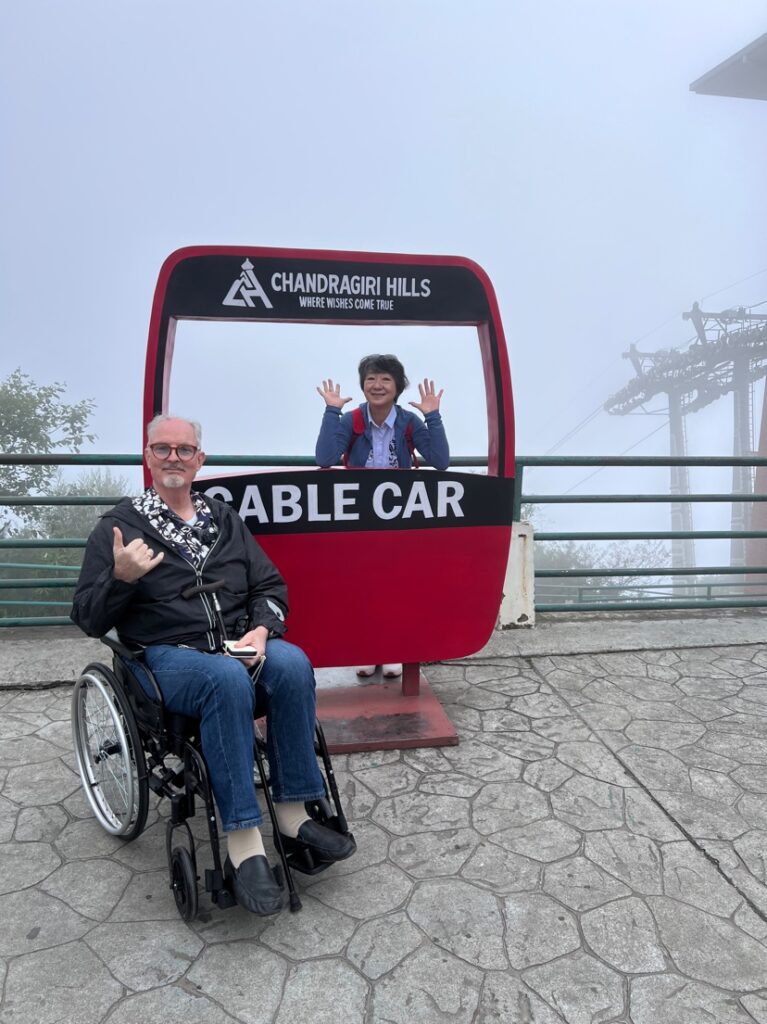
At Chandragiri Hills, access depended on planning the complete visitor pathway, not merely identifying a cable-car attraction.
Access Begins Before Arrival
The strongest accessible journeys begin long before the airport. They begin with listening.
What kind of mobility equipment does the traveller use? Which transfers require assistance? What doorway widths, bathroom arrangements, seating, rest periods or companion support matter? How much uneven ground is manageable? Which experiences are essential, and which alternatives would still feel worthwhile if weather, road conditions or site access changed?
These are not minor operational details. They determine whether an itinerary is realistic.
The Himalayan Circuit approach is to identify priority access requirements, verify selected services, coordinate suppliers and support, and respond when barriers arise. The focus is not on claiming that Nepal has become universally accessible. It is on whether pre-trip information matches the actual experience and whether agreed priority requirements are delivered as planned or through alternatives accepted by the traveller.
That distinction matters. A hotel may describe itself as accessible while the route from the vehicle to the room includes a threshold. A heritage site may offer a broad courtyard but also contain irregular paving, steps or crowded approaches. A scenic experience may be reachable by road or cable car, yet the final viewing area may still require assistance.
Responsible planning verifies the entire chain.
| THE PLANNING PRINCIPLE Start with the person, not the standard itinerary. Record service-relevant requirements, verify the actual route through each service, agree on acceptable alternatives and retain flexibility for changing conditions. |
Heritage Without Pretending the Barriers Are Gone
Kathmandu Valley is one of Nepal’s great cultural landscapes. Its historic squares and religious sites are living places of worship, trade, movement and community life, not controlled museum interiors.
Their cultural richness also creates practical complexity. Stone paving may be uneven. Kerbs, stairs, narrow passages and dense visitor movement can interrupt an otherwise usable route.
This does not mean the Valley must automatically be excluded. It means each visit requires a site-specific plan: the closest suitable vehicle approach, a checked entrance, realistic timing, assistance on difficult surfaces, a quiet place to pause and a clear understanding of which areas may remain inaccessible.
At Boudhanath, the traveller was positioned within the open public space around the stupa, accompanied by members of the team. In a historic Kathmandu square, the traveller was again within the cultural setting rather than observing from a distant vehicle. At another temple courtyard, close assistance supported movement across a busy paved area.
The important story is not that the barriers disappeared. It is that participation was planned and supported.
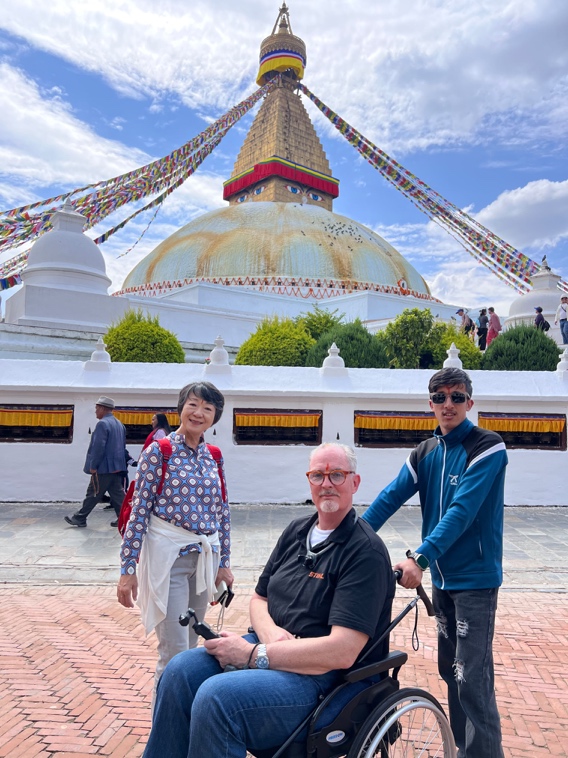
Within the open space of Boudhanath, the traveller shares the cultural setting with the support team. This moment does not certify every approach or facility at the site.
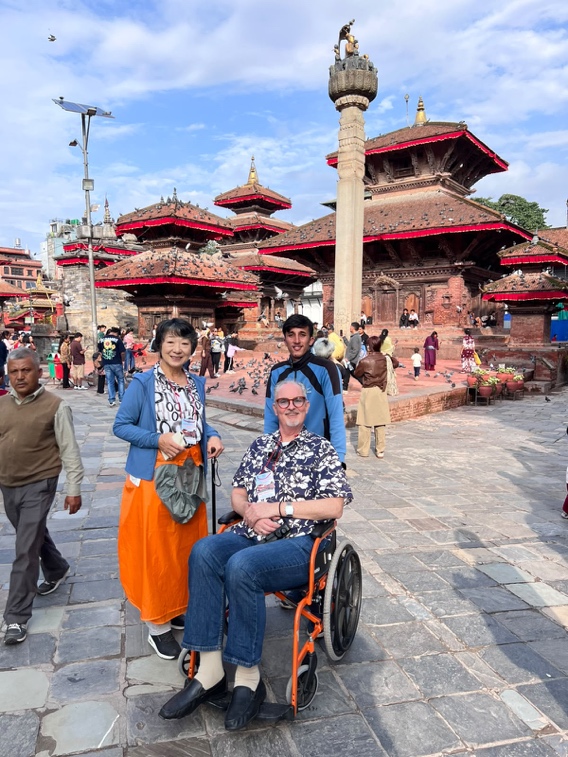
A supported visit in a historic Kathmandu square, where paving, thresholds, crowds and vehicle approaches require route-specific planning.
Inclusion is not achieved by claiming that every corner is accessible. It is achieved by making honest choices about what can be experienced, how it can be experienced and what support is required.
The Himalayas Are More Than a Trekking Trail
Nepal’s mountain identity is often communicated through trekking: long days on foot, suspension bridges, stone staircases and high passes. That experience is important, but it is not the only way to encounter the Himalayas.
A mountain journey can also be created through a road-accessible hill stay, a viewpoint reached with verified vehicle access, a carefully selected cable-car outing, a scenic flight or an individually assessed aviation experience. It can include unhurried time in a lodge or outdoor setting where the landscape itself is present.
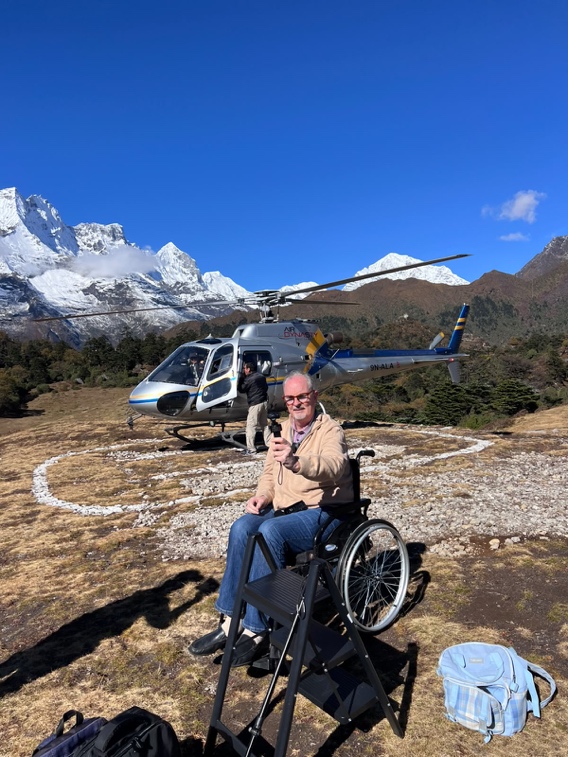
The October journey included a high-Himalayan helicopter experience. The photographs show the traveller outdoors in a wheelchair with a helicopter and mountain landscape behind, as well as a group photograph holding a welcome banner.
The photographs do not, by themselves, establish the aircraft transfer method, landing altitude, medical suitability or universal availability of the experience. Those details must be assessed and confirmed for the individual traveller and the specific operation.
That boundary does not reduce the significance of the experience. It strengthens it. The traveller was not offered an imitation of Nepal. The itinerary found a form of access to a real Himalayan setting, supported by a team and an operating plan.
A high-Himalayan moment from the October 2026 journey. Aviation experiences require individual assessment and operator confirmation.
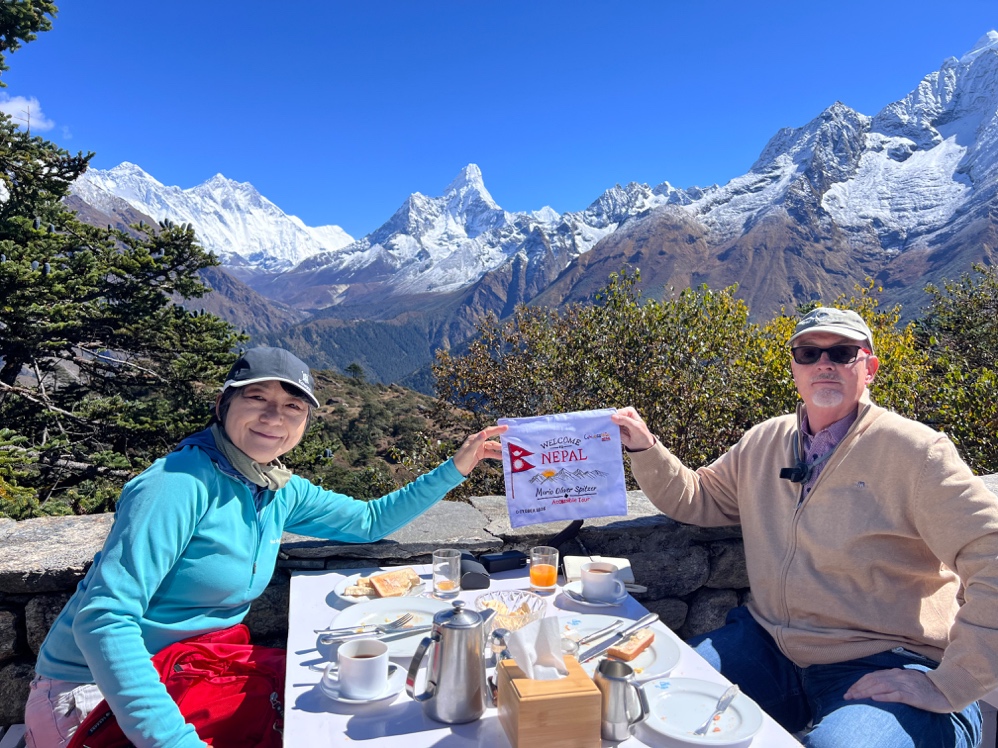
A later photograph of breakfast against a dramatic mountain backdrop adds another dimension. Accessible travel is not only about reaching a place. It is about having time to be there.

A shared breakfast with a panoramic mountain backdrop, placing comfort, time and presence at the centre of the experience.
Accessible Travel Is Not a Single Route
Accessible tourism in Nepal should not be reduced to one itinerary or one traveller profile. A more useful approach is to identify possible experiences and assess each one against the traveller’s actual requirements.
Selected heritage courtyards, stupas, cultural neighbourhoods, museums and viewpoints may be included after checking vehicle approaches, surfaces, steps, toilets, crowd patterns and rest points. In Pokhara and nearby areas, lakeside stays, scenic drives, selected viewpoints and relaxed outdoor time may support a lower-intensity journey.
A lodge-based itinerary in Chitwan may combine landscape, culture and wildlife-related activities selected according to the traveller and current operating conditions. Lumbini may support a slower cultural and contemplative programme using vehicle-assisted movement and selected stops.
Hill and mountain experiences may include road-accessible accommodation, verified viewpoints, selected cable-car settings, and individually assessed scenic or aviation experiences. Rural stays may be adapted around food, conversation, culture and landscape where hosts agree and practical access can be arranged.
None of these possibilities constitutes an accessibility certification. Hotel rooms, vehicles, pathways, entrances, toilets, transfers, weather conditions, equipment handling and emergency arrangements must be checked individually before travel.
Human Support Is Part of the Infrastructure
Ramps, lifts, adapted bathrooms, vehicles and equipment matter. So do people.
Where physical infrastructure is inconsistent, trained and respectful human support often determines whether an agreed experience can proceed. That support may include checking routes, assisting on uneven surfaces, coordinating with drivers and hotels, handling equipment, managing crowds, adjusting the pace and responding when conditions differ from what was expected.
Human support should never erase the traveller’s agency. Assistance must be discussed rather than imposed. The traveller should be told what the route involves, asked how they prefer to be supported and given real choices when a barrier appears.
Dignity is not an optional tone of service. It is part of access itself.
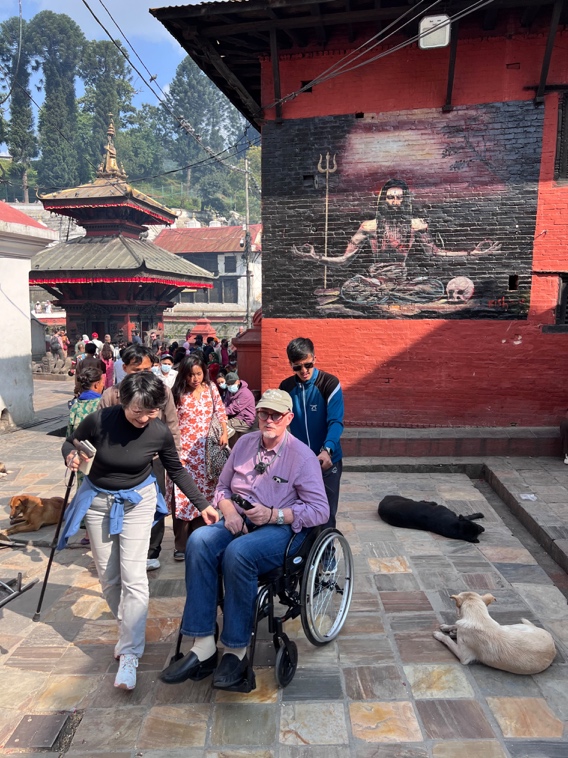
Support should be practical, respectful and directed by the traveller.
Six Questions to Ask Before Booking Nepal
1. What has been physically verified?
Ask for the current route from airport arrival to the vehicle, room, bathroom, dining area and each planned attraction. A general “accessible” label is not enough.
2. How will transfers work?
Clarify vehicle entry, seat transfers, lifting preferences, wheelchair dimensions, storage, battery or charging requirements and who will provide assistance.
3. Which barriers remain?
Request direct information about steps, slopes, surfaces, doorway widths, toilets, crowds and distances. Honest limitations are more useful than reassurance.
4. What alternatives are available?
Agree in advance on acceptable substitutes if weather, road conditions, equipment, access or operations change.
5. Who provides support?
Understand the respective roles of the guide, driver, companion, hotel team and any additional assistants. The traveller’s preferred form of assistance should be discussed directly.
6. How flexible is the pace?
Allow rest periods, buffer time and fewer daily transitions. A successful accessible itinerary is measured by the quality of participation, not simply by the number of sites visited.
The Honest Meaning of “Nepal Is Accessible”
The phrase is powerful, but it must be used responsibly.
It should not mean that every trail, temple, hotel or vehicle in Nepal is barrier-free. It should mean that a traveller is not dismissed at the first mention of a wheelchair or mobility limitation.
It should mean that the operator listens, checks, adapts and explains. It should mean that the itinerary is built around what matters to the traveller and that barriers are discussed before they become surprises.
The October 2026 journey became a milestone for Himalayan Circuit because it brought this principle into visible practice. The smiles in the photographs capture genuine moments from the tour, but the deeper evidence sits behind them: preparation, coordination, flexibility and a team willing to make access central to the journey.
Nepal’s remoteness is real. Its terrain is real. Its infrastructure gaps are real. Yet possibility is also real.
There is no single accessible Nepal tour because there is no single accessible traveller. The right promise is not that every barrier will disappear. It is that the traveller will be heard, the barriers will be investigated, and the journey will be designed with honesty and care.
Travel with Himalayan Circuit Accessible Tours
Himalayan Circuit Accessible Tours designs journeys around the person travelling: their priorities, pace, equipment, preferred support and the experiences they most want to have.
Our role is to match the traveller with a realistic route, verify selected services, coordinate local support and communicate limitations clearly.
If Nepal has felt out of reach, begin with a conversation. Tell us what helps you travel comfortably, what barriers concern you and which parts of Nepal you hope to experience. We will explore what may be possible, what requires adaptation and what should not be promised.
Cross the barrier of assumption. Discover a Nepal journey designed around you.
| TRAVEL NOTE: Conditions, road access, weather, attraction operations and individual requirements can change. Neither this article nor its photographs certify any route, property, vehicle, attraction or aviation experience as universally accessible. Arrangements must be reverified for the individual traveller before departure. |